












Patterns of Central American Migration
Historical legacies of civil war and poorly performing economies within the context of globalization have shaped Central American Migration.
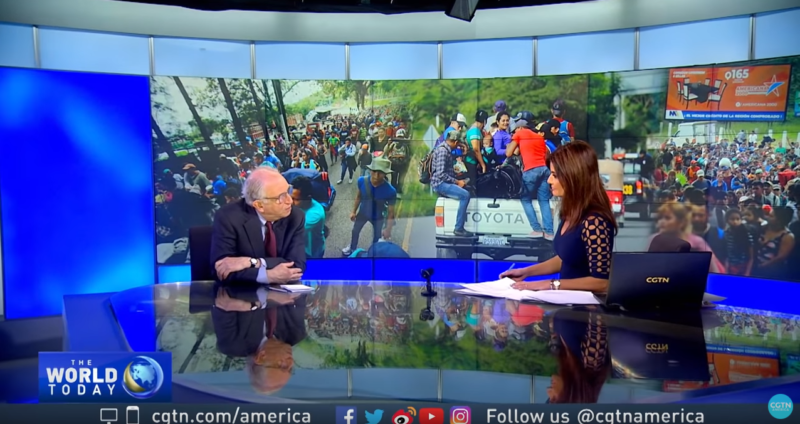 CGTN
CGTN
More than 1,500 Central Americans are heading to the United States fleeing violence and poverty. The so-called “Migrant Caravan” is currently in Mexico, where several immigrants have requested asylum. In the United States, President Donald Trump threatened to send the military force to the country’s southern border and cut aid to Central American countries. The Inter-American Dialogue’s President Emeritus and Senior Fellow, Peter Hakim, commented on the topic for CGTN America.
“[When arriving to the US,] they are going to confront different situations, some are going to try to come in illegally, others are going to ask for asylum, and some are going to be turned back very very quickly."
“Mexico will probably give them some sort of asylum. I think Mexico has a series of its own problems that are very deep and most of the people in the Caravan want to come to the United States [considering that] they have relatives in the United States, the situation in their own country is horrible, and [it is] not much better in many parts of Mexico."
"The US immigration system that is totally outdated, not very well constructed, and hasn’t been reformed in 30 years.”
“This is not an unusually large number of people. 300 people leave Honduras every day, if you take [those] and 500 from El Salvador, 500 from Guatemala, [and some more] you have 1500 people a day [that] are just moving out. This is only 3 or 4 days of immigrants from those countries and they happened to join together in part because it gives them some security. But this is not a huge increase in the numbers coming to the border.”
“This is an issue, of course, that is very useful for the Republicans and for Trump in the upcoming election.”
“[It is impossible to reach a consensus before the midterm elections, since] they have not been able to do it in 25 years. Both sides have become rather stuck in their position and this just doesn’t do good for the United States – to have this sharp division over immigration. It makes no sense at all.”
Historical legacies of civil war and poorly performing economies within the context of globalization have shaped Central American Migration.
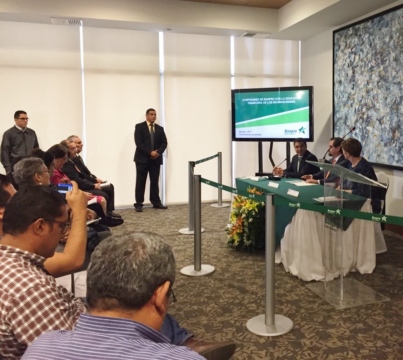
En alianza con Banpro y la Alianza para las Migraciones en Centroamérica y México, nuestro programa de inclusión financiera generó US$960,000 en ahorros.
 Video
Video
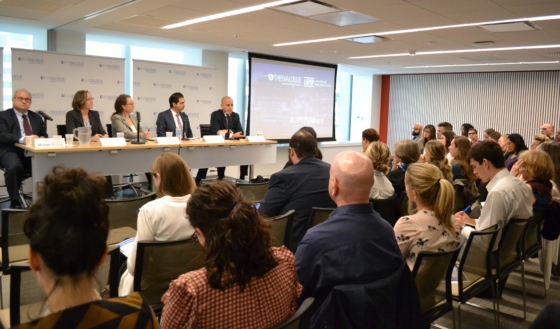
On October 3, the Inter-American Dialogue hosted an event entitled “How Insecurity Shapes Daily Life in Central America” to discuss a report recently published by the Inter-American Dialogue and the Latin American Public Opinion Project (LAPOP) on crime avoidance in Central America. The event was moderated by Michael Shifter, with the speakers including Elizabeth Zechmeister, Carole Wilson, Michael Camilleri, and Juan Gonzalez. The panel discussed the report’s methodology and findings, as well as some of the broader implications of the research for policymakers in Latin America and the United States.