












ONLINE EVENT: After the Vote—What’s Next for Mexico’s Judiciary?

Youtube / France24

Share

Authors

    Topics

    Related Links

    Shifter: Good News for Former President Álvaro Uribe
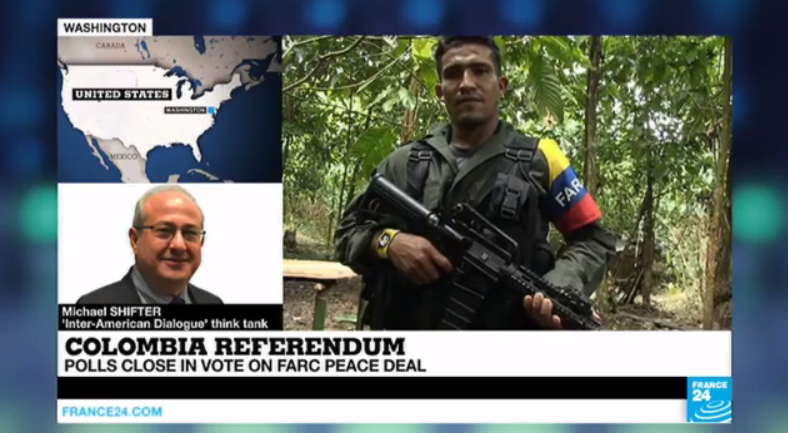
    “The results show that, although voting has exceeded the threshold that was needed, the No vote is a lot stronger than the polls had suggested, and that’s something that must be of enormous concern to the government of Juan Manuel Santos.”

    In this interview with France24 Michael Shifter analyzes the results of the Colombian referendum as they come in, describing the implications and consequences of the vote. 

    “The deal was unpopular because, first of all, there is a sense that the FARC committed crimes against humanity and other serious atrocities, were not going to jail, that there would be impunity. They were not convinced that they would pay the price for their crimes. And secondly they didn’t like the fact that they would go from an insurgency, a guerrilla movement, into a political organization.”

    Watch the complete interview via France24


    COMENTARIOS DE TARACIUK BRONER:

    Q & A:

    Q

    ¿Qué tan válido ves tú — o legítimo — el temor que reporta la Casa Blanca de que aumente la migración haitiana?

    A

    “Una política de seguridad que funcione debe tener dos pilares: una visión punitivista donde quien comete un delito vaya preso, pero con debido proceso y bajo investigaciones por un poder judicial independiente y, por otro lado, una serie de políticas que sean más sociales y preventivas que eviten la comisión del delito.” 

    View Video Clip

    Key Findings

    Suggested Content

    Chavez: “A direct intervention in Venezuelan territory with the intention of deposing Maduro would have devastating consequences.”

    In an interview with Valor Econômico, Inter-American Dialogue president and CEO Rebecca Bill Chavez warned that U.S. military operations in Venezuelan territorial waters could violate

    Santos: “Today, we are the only public policy program in Washington fully dedicated to Brazil and its relationship with the United States.”

    Bruna Santos, director of the Brazil Program at the Inter-American Dialogue, told Exame that there is “no short-term solution” to the Brazil–U.S. political crisis, stressing

    Stanton: “A holistic early warning system is essential to identify students at risk of dropping out while they are still in the classroom rather than waiting for them to abandon it.”

    Sarah Stanton, education program manager of the Inter-American Dialogue, spoke with Jamaica's Nationwide This Morning to discuss the findings of the Jamaica Education Report Card

    Subscribe To
    Latin America Advisors

    * indicates required field

    This site is protected by reCAPTCHA and the Google Privacy Policy and Terms of Service apply.

    The Inter-American Dialogue Education Program

    SUBSCRIBE TO OUR NEWSLETTER / SUSCRÍBASE A NUESTRO BOLETÍN:

    * indicates required