







Can Spain Solve the Cuba Problem?
By all accounts, Spain wants to bring change to the European Union’s Cuba policy. In so doing, it is tackling a foreign policy challenge that often sheds more heat than light.
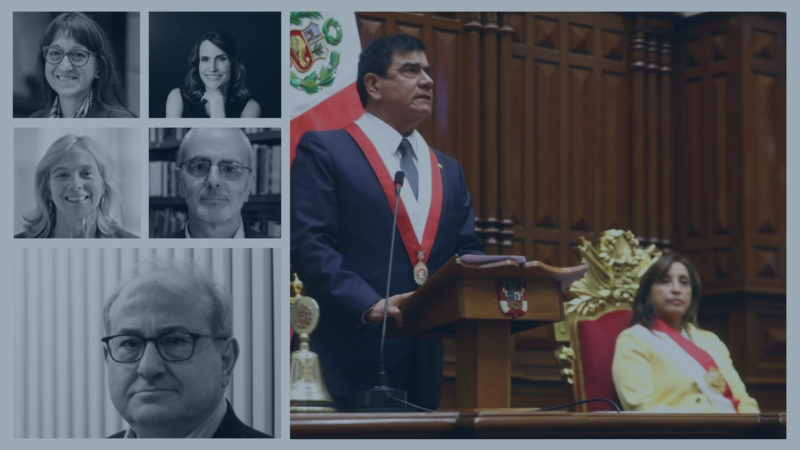 Featured image: Twitter Congreso de Perú
On December 7, 2022, Peruvian President Pedro Castillo of Peru attempted a “self-coup” (autogolpe) by dissolving the legislative branch, which would allow him to rule by decree. The attempt failed, President Castillo was arrested, and Vice President Dina Boluarte was sworn-in as Peru’s first female president. To discuss the implications of this attempted autogolpe for Peru and the region, the Inter-American Dialogue hosted an online event titled “Peru’s Precarious Politics — The Crisis Deepens” on December 15, 2022.
After welcoming remarks from Dialogue President and CEO Rebecca Bill Chavez, senior fellow and moderator of the event, Michael Shifter shared his assessment of the crisis. After summarizing the events that directly followed the attempted autogolpe, Shifter determined that, even though elections are forthcoming, a democratic political successor to Boluarte is not clear. Castillo has been mobilizing his supporters from his jail cell, and the continuing crisis is tense and fast-moving. Shifter asked the panel for their general thoughts on the situation - to comment on President Boluarte and her initiative to advance elections, to explore the implications for Peruvian democracy and the prospects for constitutional reform, to examine how this crisis will affect Peru’s economy, and to assess the international community’s response.
Cynthia McClintock, professor of political science and international affairs at George Washington University, commented that President Boluarte is doing what Castillo should have done from the start by appointing qualified ministers and building bridges with a right-leaning congress. However, she doubted Boluarte’s ability to control the crisis and warned that her impeachment would instate President of the Congress Jose Williams as president – a retired general with close ties to the military. Economically, Peru’s tourism and mining industries have been damaged by the crisis, and the continued protests from Castillo’s supporters demonstrate the dissatisfaction with the current economic system. McClintock concluded by observing that she sees no reform on the horizon that can strengthen Peru’s historically weak political parties.
Centering her remarks around the economy, Roxana Barrantes Cáceres, principal professor of economics at Pontificia Universidad Católica del Perú, said there were both positive and negative developments resulting from the crisis. On the positive side, it appears Peru’s exchange rate has been reacting more to the actions of the US Federal Reserve than the political developments in Peru, and that inflation has been gradually improving. On the other hand, Peru has seen weak private investment since 2021, an absence of major mining projects, a damaged tourism industry, and food insecurity. Barrantes Cáceres judged that Castillo was ultimately better at campaigning than governing.
For Farid Kahhat, senior lecturer in the Department of Social Sciences at Pontificia Universidad Católica del Perú, the continued weakness of Peru’s political parties is key to understanding the crisis. Kahhat analyzed how the political parties of the last four presidents in Peru failed to present candidates in subsequent elections. Adding to this, Peru’s politicians have weaponized the country’s constitution. Congress has abused provisions allowing for the removal of the president, while the president has abused provisions allowing for the shuttering of Congress.
During the Q&A portion of the event, panelists outlined the challenges facing President Boluarte, the influence of political militant Antauro Humala, and the factors driving lower investment in Peru. Asked to define both the “right” and the “left” in Peru, Kahhat reminded the audience that the right in Peru also has authoritarian tendencies, while the left consists of a mix between ideological and pragmatic elements. The panel agreed that Castillo himself was not very progressive on social issues such as girls’ access to education, abortion, and same-sex marriage and that he failed to deliver on progressive, redistributive, and fiscal reforms. Turning to the regional response, the panel found the statements released by left-leaning leaders across the region disappointing and worrisome. The panel concluded by discussing how dissatisfaction with socioeconomic conditions is fueling unrest in Peru and other Latin American countries.
By all accounts, Spain wants to bring change to the European Union’s Cuba policy. In so doing, it is tackling a foreign policy challenge that often sheds more heat than light.
When Haiti was struck by a devastating earthquake, the administration of U.S. President Barack Obama quickly absorbed the depth of the tragedy and necessity of a robust U.S. response. Unless the U.S. adopts a proactive role, Haiti’s fragmented political landscape threatens to deteriorate into a political vacuum that will compound the current crisis.
Politics is swirling everywhere. Such are the ways of democracies, especially when oppositions come alive and defeat or threaten incumbents.