












Is Latin America Ready to Cope with Climate Change?
As global temperatures continue to rise with the global community stalled on any way to stop them, countries must prepare to adapt to increasingly volatile environmental conditions.
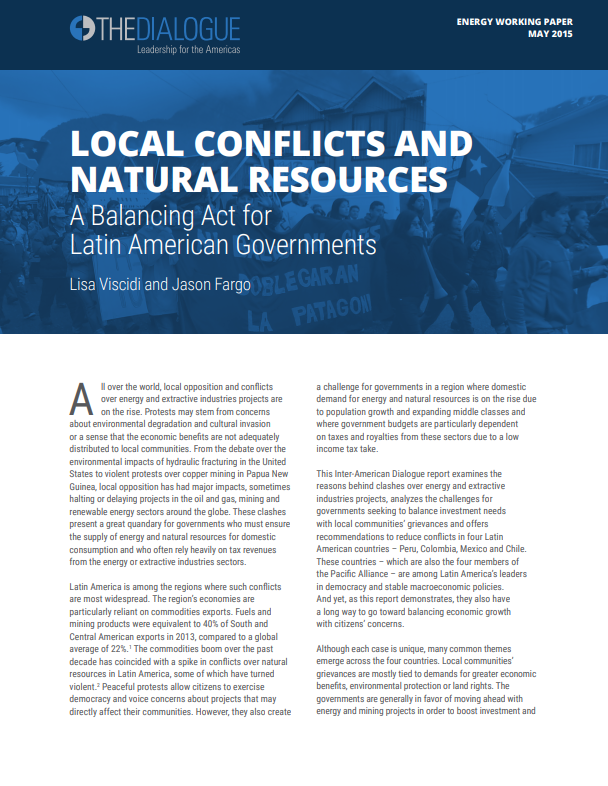
Conflicts over energy and natural resources are leading to social turmoil and posing serious challenges for investment projects all over Latin America. To better manage such conflicts, Latin American governments must step up their involvement in the consultation process and communicate more effectively with local communities about potential social, environmental and economic impacts, according to a new report by the Inter-American Dialogue.
The commodities boom over the past decade has coincided with a spike in conflicts over natural resources in Latin America. Protests may stem from concerns about environmental degradation or a sense that the economic benefits are not adequately distributed to local communities. These clashes present a great quandary for governments that must ensure the supply of energy and natural resources for domestic consumption and that often rely heavily on tax revenues from the energy or extractive industries sectors.
This Inter-American Dialogue report, co-authored by Lisa Viscidi, Director of the Energy, Climate Change and Extractive Industries Program, and Jason Fargo, Latin America Team Leader at Energy Intelligence Group, examines the reasons behind conflicts over energy and extractive industries projects, analyzes the challenges for governments seeking to balance investment needs with local communities' grievances, and offers recommendations to reduce conflicts in four Latin American countries – Peru, Colombia, Mexico and Chile.
These countries – which are also the four members of the Pacific Alliance – are among Latin America's leaders in democracy and stable macroeconomic policies. And yet, as this report demonstrates, they also have a long way to go toward balancing economic growth with citizens’ concerns. In all four cases governments lack clear processes, adequate resources and the political capacity to prevent and defuse conflicts. Communities are often not adequately engaged in consultations throughout the project and are not given sufficient information about the plans and potential impacts. Despite the challenges, cases of successful consultation and a growing understanding of best practices suggest these conflicts can be successfully managed and avoided.

As global temperatures continue to rise with the global community stalled on any way to stop them, countries must prepare to adapt to increasingly volatile environmental conditions.
As the global financial crisis continues to alter US relations with the hemisphere, greater engagement in the region remains critical to US interests.
Unless resource nationalism can be made compatible with providing incentives for significant foreign participation, it may be too early to start trumpeting a bonanza for Latin America.