

Wikileaks & Latin America
Wikileaks has made international diplomacy more complicated for the US—or at a minimum more awkward.
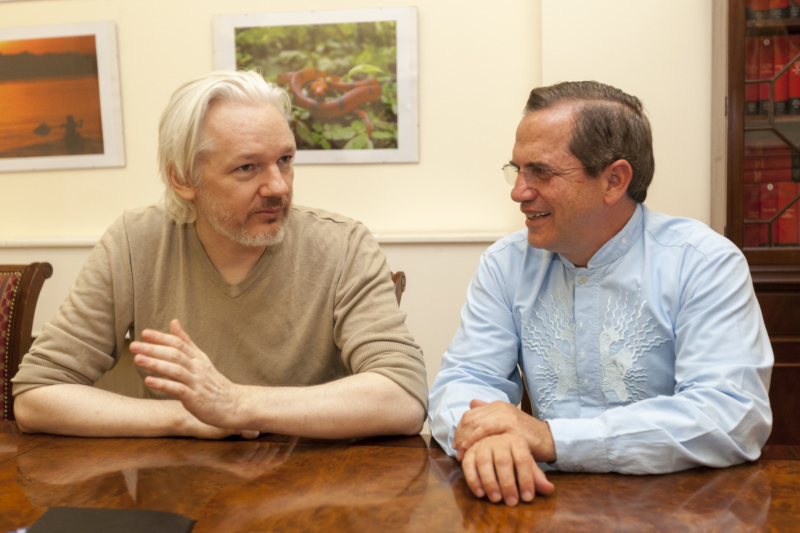 Flickr / Cancillería del Ecuador / CC BY-SA 2.0
Ecuador has now confirmed that it cut off internet access at their London Embassy for Julian Assange, the leader of the group WikiLeaks, who has been staying at the embassy since 2012. NPR's Kelly McEvers talks to Michael Shifter, president of the Inter-American Dialogue, about what Ecuador's calculus might be.
KELLY MCEVERS, HOST: Several big surprises in the presidential campaign have come from hacked emails released by WikiLeaks. Now Ecuador says it has decided to temporarily restrict Internet access for WikiLeaks founder Julian Assange at their embassy in London. In a statement, Ecuador says they do not, quote, "interfere in external electoral processes."
Assange has been holed up in Ecuador's embassy since 2012, when Ecuador granted him asylum. I talked about all this with Michael Shifter. He's president of the Inter-American Dialogue. That's a think tank in Washington. And I asked him first to explain why Ecuador granted Assange asylum in the first place.
MICHAEL SHIFTER: Ecuador saw this as a defiance of the United States. They saw that the United States was really against Assange, and there was an expression of solidarity. And Ecuador was trying to look for a place on the global stage.
MCEVERS: And this, of course, did not make American officials happy, of course, because of WikiLeaks' release of American documents in the past. Did that matter to Ecuador at the time?
SHIFTER: It mattered less certainly than it does today. Ecuador, four years ago, was doing a lot better economically. Oil prices were still high. And Rafael Correa, the president of Ecuador, was in very good shape, and so he was very popular. The economy is not contracting as it is today. And so this was a way to clash with the United States, but with very little cost. Things were going pretty well in Ecuador, and that situation has changed dramatically.
MCEVERS: Right. So now - why the change? Why've they decided to restrict Assange's internet access?
SHIFTER: Well, it's a combination, I think, of reasons. One is because Assange has gone too far in what is seen as a collaboration with Russia to try to interfere in the U.S. elections and also...
MCEVERS: By releasing hacked emails.
SHIFTER: By releasing hacked emails - correct. And I think even for the Ecuadorian government, which often clashed with Washington, this was going too far and made Correa very, very uncomfortable. And the second reason is because of its own serious economic difficulties in Ecuador. Ecuador needs the United States. There's no free trade agreement, but the United States is by far the largest trading partner of Ecuador. It imports more from the United States than any other country, exports more of its products to the United States than any other country. And it cannot afford to increase antagonism at this time. And so it had a pull back and draw the line and get some distance between itself and Assange.
Wikileaks has made international diplomacy more complicated for the US—or at a minimum more awkward.
How will diplomatic relations between Ecuador and the US be affected after the expulsion of US Ambassador Heather Hodges?
Where do relations stand between Ecuador and the United States today, and how might the arrival of a new ambassador in Washington affect ties between the two countries?