


Europe Might Take Another Step Back
If Spain fails to have the Common Position lifted or if it succeeds and Havana again turns down European economic cooperation, then Cuba wins once more.
 BBC
BBC
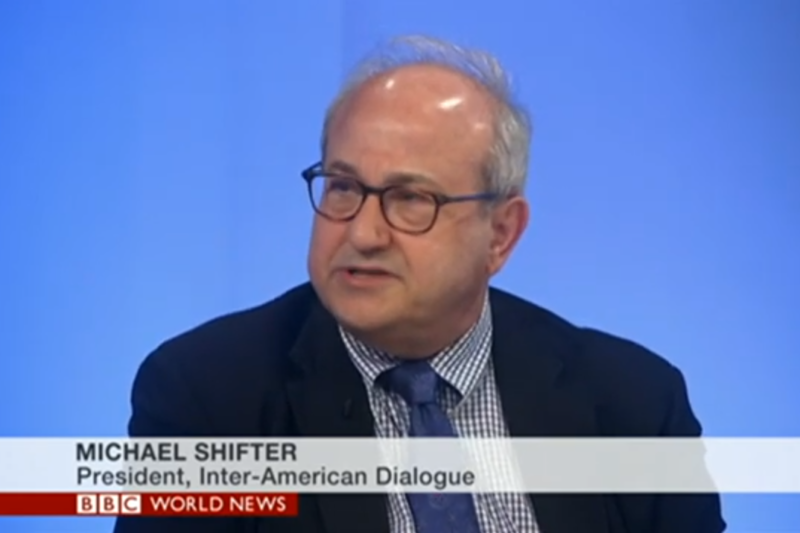
Michael Shifter spoke with Laura Trevelyan on BBC World News to analyze the future of Juan Guaidó and the Venezuelan military as the pressure coming from the Trump administration.
“In some respect [the actions on April 30] are a step forward, [Guaidó] certainly has more support from the Venezuelan military today than he did yesterday. The question is, is it enough to really force the collapse of the regime? Which of course is the objective of Guido and his supporters. I think we see today that it wasn't enough to force the regime to fall but it's enough to show that there's pressure from the streets and also from some ranks of the armed forces that have turned to Guaidó."
"The hope is that [the military] will interpret today's results as showing this process [of military officers turning towards Guaidó and abandoning Maduro] is really building. Instead of having a violent end to this crisis [the military can] try to engage in negotiations, to look for some formula that may lead ultimately towards a transition. The other possibility is that [the military] will see this as a real threat to them, they will dig in and there'll be massive repression. I think it can go one of two different ways and hopefully it will go the first."
"Clearly the US is fully supporting Guaidó. One of the people [Bolton] mentioned was the Minister of Defense, Padrino. There have been conversations but certainly today Padrino did not abandon Maduro, Padrino is still with Maduro and he gave a press conference and he showed that he's still supporting the government. There is pressure from the Trump administration but there's a lot of pressure on the military to stay loyal to Maduro."
"Mr. Bolton said in his comments today [that this is the] last chance for democratic transition and if not Venezuela will sink into a long-term dictatorship. I think that imagery evokes the Bay of Pigs in Cuba which was a long term dictatorship [that] we still have today. I think in Venezuela the situation is dramatically different, there's still more possibilities of dialogue. There is an opposition in Venezuela today, there was no opposition in Cuba in the early 1960's so we have a different situation."
"It's hard to overstate [the current situation in Venezuela]. Five thousand people a day are going to Colombia and the border already has a million and a half refugees. There are people that are literally starving to death, having a meal once every couple of days. The images are really heartbreaking, the situation is very serious and there is an urgency to try to reach some sort of resolution. That resolution could happen through violence or it could happen through more peaceful means and my hope is that today will help create the conditions for a negotiated end to this tragedy."
If Spain fails to have the Common Position lifted or if it succeeds and Havana again turns down European economic cooperation, then Cuba wins once more.
Hugo Chavez, the Venezuelan president, has clearly been enticed by the Libyan drama, where his longtime friend and ally, Muammar al-Qaddafi, is under siege from rebel forces.
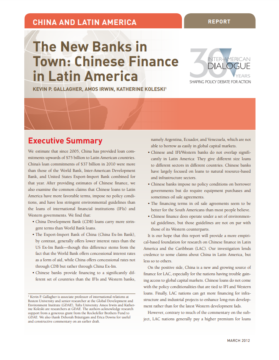
Estimates of the volume, composition, and characteristics of Chinese lending to the region since 2005.